
Chapter Content
The MTProto Protocol: Cryptographic Architecture
16.1 Overview of the MTProto Protocol
MTProto is a custom mobile protocol family designed by Nikolai Durov specifically for Telegram. It was engineered to deliver low-latency communication over weak or unstable mobile connections while providing transport encryption and data integrity.
16.2 Cryptographic Foundations (MTProto 2.0)
MTProto 2.0 employs established cryptographic primitives: Diffie-Hellman key exchange for establishing session authentication keys, SHA-256-based cryptographic constructions for message-key and integrity-related processing, and AES-256 (in Infinite Garble Extension / IGE mode) for symmetric payload encryption.
   [Key Exchange]    ----> Diffie-Hellman Key Agreement Protocol
   [Integrity/Keys]  ----> SHA-256-Based Message-Key & Integrity Processing
   [Data Encryption] ----> AES-256 (IGE Mode) Symmetric Cipher
   [Serialization]   ----> Type Language (TL-Schema) Binary Formatting
16.3 Technical Distinction: Cloud Chats vs. Secret Chats
A crucial technical distinction in Telegram's architecture is the difference between Cloud Chats and Secret Chats: 1. Cloud Chats (Default for 1-on-1, Groups, and Channels): Use client-server encryption. Messages are encrypted in transit between the client device and Telegram's distributed cloud servers. Messages are stored encrypted across Telegram's server clusters, enabling seamless multi-device synchronization and instant search across chat histories. 2. Secret Chats (Optional 1-on-1 Chats): Use End-to-End Encryption (E2EE). Messages are encrypted on the sender's device and decrypted only on the recipient's device. Encryption keys are maintained by the participating devices and are not uploaded to Telegram's cloud for synchronization. Secret chats do not sync across multiple devices and support self-destruct message timers.
It is a common misconception that all Telegram chats are end-to-end encrypted by default. By default, Telegram uses client-server encryption for Cloud Chats to provide instant multi-device cloud synchronization, while providing optional end-to-end encryption through Secret Chats.
// =========================================================================
// EDUCATIONAL MODEL — NOT TELEGRAM'S PRODUCTION SOURCE CODE
// Demonstrates binary payload wrapping, message IDs, and checksum calculation concepts
// =========================================================================
#include <iostream>
#include <vector>
#include <cstdint>

struct ConceptualPacket {
    uint64_t auth_key_id;
    uint32_t session_id;
    uint32_t message_id;
    std::vector<uint8_t> payload;
    uint32_t checksum;
};

ConceptualPacket BuildConceptualPacket(uint32_t session, uint32_t msg_id, const std::string& data) {
    std::vector<uint8_t> bytes(data.begin(), data.end());
    uint32_t dummy_checksum = 0xA1B2C3D4; // Conceptual hash
    return ConceptualPacket{0x1234567890ABCDEF, session, msg_id, bytes, dummy_checksum};
}

int main() {
    auto packet = BuildConceptualPacket(101, 202, "SyncUpdate");
    std::cout << "[INFO] Conceptual packet generated. Message ID: " << packet.message_id << std::endl;
    return 0;
}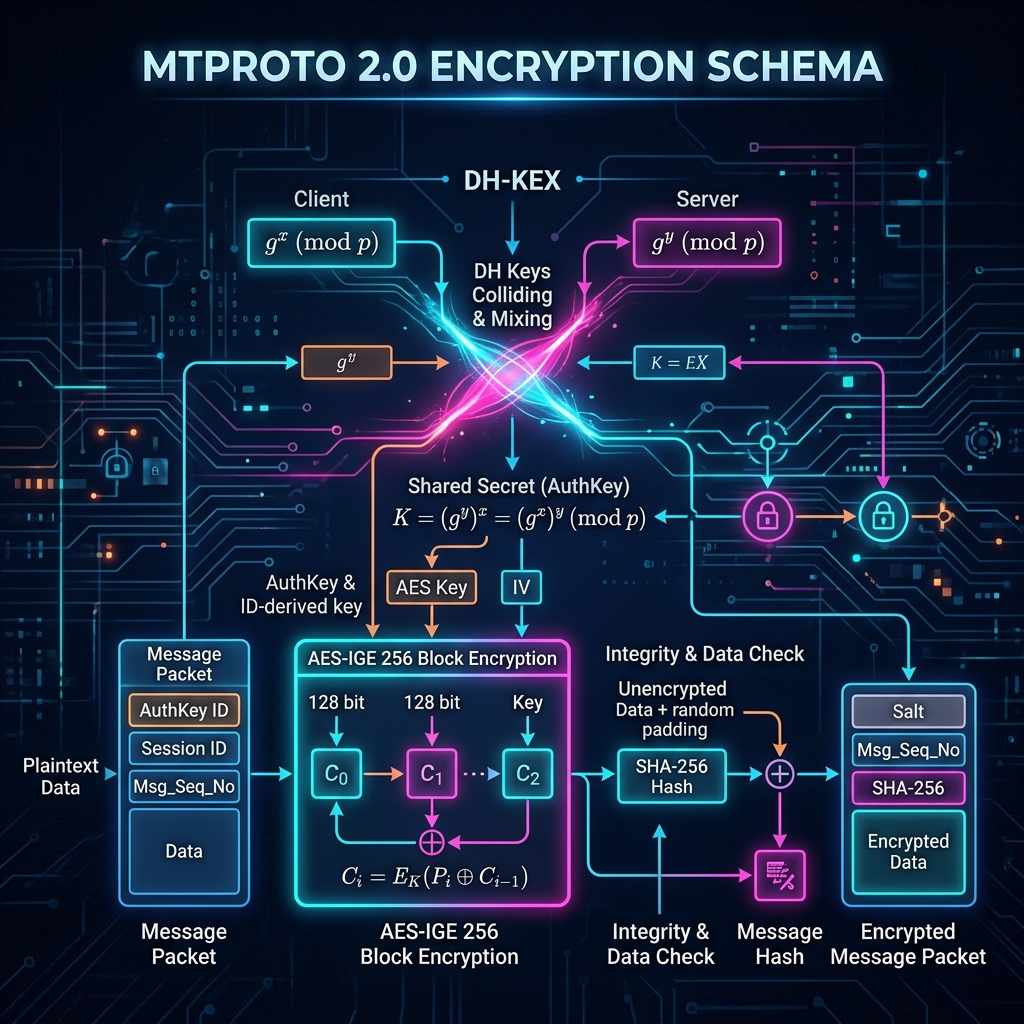
Diagram of key generation, SHA-256 message integrity verification, and AES-256 transport payload encryption.